
Companies
Agent
Welcome to Westing Agency Pte Ltd (Singapore)
Copyright 2010. All Rights Reserved. This website last modified on Friday, August 20, 2010
Companies
Agent

Promotions
Testimonials

Latest News

Individual


Coverage < Back to At A Glance
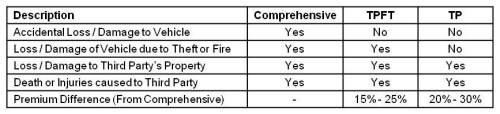
There are two types of motor insurance: Private and Commercial. Private motor insurance covers passenger vehicles such as cars or motorcycles meant for private use. Commercial motor insurance will cover vehicles such as trucks, vans, lorries for business use. There also essentially three types of coverage offering in the Singapore market, namely Comprehensive, Third Party Fire & Theft (TPFT) and Third Party (TP) only. It is mandatory by law to have Third Party's insurance coverage if you are driving a motor vehicle in Singapore.
Comprehensive Motor Policy - covers loss or damage to vehicle arising out of an accident. Most insurance companies would extend to cover flood or other natural disasters in the Comprehensive policy. Third Party Fire & Theft Policy - covers loss or damage to vehicle as a result of a fire or theft. Third Party Only Policy - covers death of or bodily injury to any person and losses or damages to any persons' property, as a result of an accident.
In Singapore, most vehicles are insured under Comprehensive coverage due to most of the cars being less than 5 years, the higher accident rate and the convenience of the insurance company handling all claims. In fact, the premium difference between Comprehensive and Third Party policy is marginal, usually by between 10% - 30% depending on vehicles and insurance companies. Hence vehicle owners purchase Comprehensive coverage as they do not see substantial savings in buying a Third Party policy.
Features & Benefits < Back to At A Glance
Please note that these key features or benefits are offered under a Comprehensive Motor Policy and the benefit amounts differ from insurance companies to insurance companies. It may be wise to make a check before you commit to the policy.
(1) Loss or Damage to Own Vehicle
(2) Removal of Vehicle after an Accident (Towing)
(3) Third Party's Liability
(4) Medical Expenses incurred due to an accident (direct and immediate result of an accident to the Vehicle)
(5) Personal Accident Benefits (Death, physical disabilities sustained as a direct and immediate result of an
accident to the Vehicle)
(6) No Claim Discount (it starts with 10% after a claim-free's first year and will increase 10% each year up to
50%)
(7) Windscreen Replacement
(8) Replacement Car or Transport Allowance if the vehicle is in the workshop for repairs due to an accident
(9) No Claim Discount Protector
(10) Certificate of Merit Discount
For items 8-10, please see Important Information below.
Important Information < Back to At A Glance
No Claim Discount (NCD) - this is a discount given by insurance companies to reward customers with no claims made in a policy year. The discount starts with 10% after the first year and will increase by 10% each year (and up to a maximum of 50%) if there are no claims made to the policy. Any claims made will reduce the NCD by 30% at the end of the policy year. Let's say you have 20% NCD after 2 years and you suffer an own damage accident in the 3rd year. Your NCD will be reduced by 30% and it will become 0% immediately.
NCD Protector (NCDP) - Some insurance companies offer NCDP to their customers with 50% NCD at a cost of between 8% - 12% of the standard premium. With this benefit, the customer's NCD 50% can be protected even in the event of an accident which the customer is at fault. However, this NCDP is not recognized by other insurance companies and they may still reduce your NCD to 20% if you decide to switch insurer upon renewal.
Certificate of Merit (COM) - this discount of 5% is given by some insurance companies in recognition of an 'offence-free' driving record maintained by the insured. This means that the customer has no demerit points issued by the Traffic Police for a continuous period of 3 years. To see whether you qualify for this discount, check with us whether the insurance company offers this incentive and also whether you are eligible for a COM discount. For COM, you may also go to Traffic Police's website at www.spf.gov.sg/epc or click here to bring you there directly.
Loss of Use (LOU) - Some insurance companies offer replacement vehicles or a daily transport allowance should the vehicle is sent to the workshop for an accident repair. There is usually a maximum period which this benefit will be provided and in some cases, this benefit only applies to vehicles sent to the insurer's authorized repair shop.
Excess (XS) - An excess (also known as a deductible) is an amount which you must bear in a claim. An excess is imposed commonly on Own Damage claims in Singapore but it is not unusual for insurance companies to impose an excess on Third Party claims as well due to the insured's driving record and also the insurance company's own underwriting discipline.
Unnamed Driver's Excess (UDXS) - Most insurance companies impose a higher excess for drivers whom are not named in the policy. Such excesses are limited safeguards for what insurance companies do not know is driving the vehicle. Excess ranges from $500 - $1,200, depending on insurers. Young & Inexperienced Drivers (YID) - Most if not all insurance companies imposed a YID excess on drivers who are below 23 years of old or have a driving experience of less than 2 years. The excess amount is high and usually ranges from $2,000 to $4,000.
Things to Watch Out for < Back to At A Glance
Premium - Price is definitely important but make sure you are getting the right coverage you seek. The cheapest policy may offer bare coverage which may not include LOU, carry a higher excess etc. Hence for $200 that a customer saves, he or she may end up paying $600 in additional excess should a claim arise. Know your needs and insure for the right policy.
Benefits - Customers may think that the benefits are not important. But if benefits are not important, why would someone not just buy a Third Party Only policy? Benefits are important and you should look out for those policies which offer what you want. It is often in claims situations that the Insured discovers that he is not entitled to a courtesy car when the vehicle is in the workshop for repairs. Also, some discovered that for a Third Party claim against them, they also have to pay the Excess.
Non-Disclosure - Customers are often not aware that any false declaration or non-disclosure of material facts which may affect the insurance company's decision to underwrite the risk may render any claims invalid. In another words, under the policy contract, the insurance company has the right to reject any claims due to non-disclosure of material facts or false declaration on the proposal form. Customers may choose not to declare or grossly understate a claim thinking that insurance companies are not able to find out. This is not true in Singapore as insurers have access to a common claims database these days.
Service - There are some customers who believe there is no need for an intermediary to help him arrange for motor insurance. If this is true, how would a customer know that he is getting the right coverage or the best value for his car policy? And what happens in the event of claim? An intermediary's job is varied and he can help you find insurance placement, he advises you on the risks and offers alternative solutions, he helps to mediate when there is a claim dispute and he points you in the right direction in the event of an accident.